About us
“I will instruct you and teach you in the way you should go; I will counsel you with my loving eye on you.”
— Psalm 32:8
About us
1. OUR CONGREGATION ORDER:
The Poor Clares, officially the Order of Saint Clare (Latin: Ordo
Sanctae Clarae), originally referred to as the Order of Poor Ladies,
and the Second Order of Saint Francis, are members of an enclosed
contemplative cloistered order of nuns in the Roman Catholic Church.
The Poor Clares were the second Franciscan branch of the order to be
established. Founded by Clare of Assisi and Francis of Assisi on Palm
Sunday in the year 1212, they were organized after the Order of Friars
Minor (the First Order), and before the Third Order. As of 2011, there
were over 20,000 Poor Clare nuns in over 75 countries throughout the
world. They follow several different observances and are organized
into federations.
The Poor Clares follow the Rule of St. Clare, which was approved by
Pope Innocent IV on the day before Clare's death in 1253. The main
branch of the order (OSC) follows the observance of Pope Urban. Other
branches established since that time, operate under their own unique
Constitutions as autonomous ones, are the Colettine Poor Clares (PCC)
(founded 1410), the Capuchin Poor Clares (OSCCap) (founded 1538) and
the Poor Clares of Perpetual Adoration (PCPA) (founded 1854).
2. OUR FOUNDRESS
Clare was born in Assisi to the Offreduccio household during the High
Middle Ages, the eldest daughter of Favarone or Favorino Sciffi, Count
of Sasso-Rosso, and his wife Ortolana. Traditional accounts say that
Clare's father was a wealthy representative of an ancient Roman
family, who owned a large palace in Assisi and a castle on the slope
of Mount Subasio. Ortolana belonged to the noble family of Fiumi, and
was a very devout woman who had undertaken pilgrimages to Rome,
Santiago de Compostela, and the Holy Land. Later in life, Ortolana
entered Clare's monastery, as did Clare's sisters, Beatrix and
Catarina (who took the name Agnes and was later declared a saint
herself).
Before her birth, it was revealed to her mother that her child would
be a brilliant light in the world. Clare was a beautiful girl,
possessing a good personality and a brilliant mind as well. She was
generous to the poor, and prayed often, delighting in praying before
the Blessed Sacrament. As a young girl she even wore a coarse
penitential belt under her clothing. As children, Clare and her
sisters were taught the ways of Christianity by their mother; they all
became very religious and devoted to prayer. When Clare was 12 years
old, her parents wanted her to marry a wealthy young man; however, she
protested and said that she did not want to marry until she turned
18.
At the age of 18, she heard Francis preach in Assisi during Lent in
1212. His words resonated in her heart and she knew God was calling
her to lead a life of penance, similar to Francis'. She met with him
to share her insights and feelings. She so longed for a life of
poverty, penance and prayer. Clare knew the impact her plans and
desires would have on her family, and she realized she would have to
leave home in secret as her father wanted to marry her off very
soon.
She did so on Palm Sunday, 20 March 1212, with the consent of Guido
II, Bishop of Assisi at night, and was met in a little chapel called
Our Lady of the Angels (Portiuncula) by Francis and his companions.
There, her hair was cut, and she exchanged her rich gown for a plain
robe and veil. Fully cutting a woman's hair was a symbolic act showing
that she was no longer bound by the laws of man or society but rather
that she followed the will of God.
Francis placed Clare in the convent of the Benedictine nuns of San
Paulo, near Bastia. Her father, along with other members of her
family, attempted to convince her to return home. At first, they tried
to persuade her by enticing her with wealth, and the privileges of
nobility, but she resisted each attempt, professing that she would
have no other husband but Jesus Christ. Finally, when they tried to
use force she clung to the altar of the church and threw aside her
veil to show her cropped hair. It was only after seeing her cropped
hair that her family relented and left her in peace. Her sister
Catarina unexpectedly joined Clare 16 days later and took the name
'Agnes'. She consecrated herself to God, received the coarse habit,
and the Order of Poor Ladies was begun.
3. OUR HISTORY
After a brief time with the Benedictine Sisters, Clare was moved to
the convent at San Damiano, and remained there in the cloister for the
rest of her life. She was the first woman to write her own rule for
herself and her Sisters. It was a result of 40 years of her lived
experience of contemplative life and was approved by Pope Innocent IV
in 1253. St. Clare received the document of approval as she was on her
deathbed.
Her life was one of poverty, and of service to her sisters and all who
came to the monastery, seeking prayer and counsel. The Second Order
grew rapidly in Clare's time, and among her first followers were her
own sister and her mother! Through her life of self-denial and
seclusion and deep prayer, Clare found much happiness and fulfillment.
She died in 1253, and was canonized in 1255. Her feast day is on the
11th of August. In 1958, St. Clare was chosen as the Patroness of
Television. This was because of an incident in her life where she was
able to view from her sick bed in the monastery, the Christmas Mass
celebrated in the basilica of St. Francis.
Today, there are Monasteries of St. Clare throughout the world, each
one autonomous, yet united in the spirit of poverty and sisterly
communion. Clare wished that her sisters remain united with the
followers of Saint Francis and today, the brothers and sisters from
the three Franciscan Orders still draw inspiration from the bonds
which united Francis and Clare in the thirteenth century! The daily
life of a Poor Clare combines the joy and simplicity of the Franciscan
call within the framework of a MONASTIC, CONTEMPLATIVE, COMMUNITY.
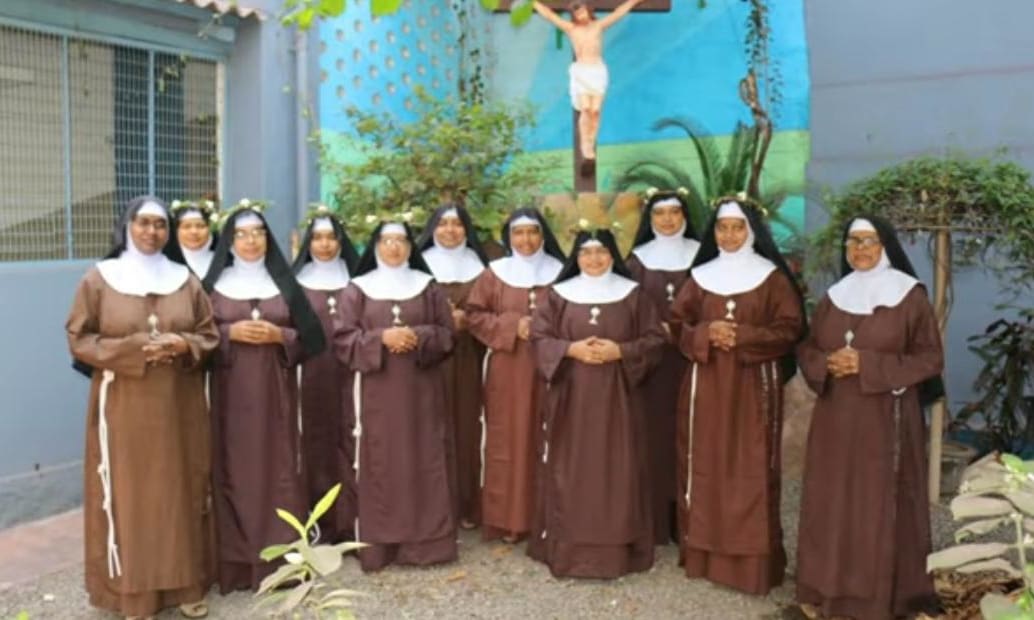
4. Our Monastery in Visakhapatnam
The story of our Christ the King Adoration Monastery started in 1984
in Visakhapatnam, one of the fastest growing cities in India, situated
in the north coastal part of Andhra Pradesh is also a divine plan of
God.
The hill where our Monastery is situated was previously known as
Galikonda where the people of Gnanapuram used to go for sight seeing.
The Statue of Sacred Heart of Jesus was erected on 15th June 1928 by
his Lordship Rt. Rev. Dr. Peter Rossillion and dedicated the entire
diocese to the Sacred Heart of Jesus. People used to celebrate the
feast of Sacred Heart of Jesus and thus once a year they used to come
up the hill.
During the tenure of Fr. Paul Maipan as the Parish Priest of
Gnanapuram, being a deeply spiritual priest, with foresight the
Galikonda was converted into a marvellous Rakshanagiri (hill of
salvation). Mysteries of the Holy Rosary and the Stations of the Cross
were erected all along the road side. Rakshanagiri simply captivates
the hearts of the people towards a faith filled Pilgrim Journey. The
place has become so powerful with all the pious activities taking
place there and that the people come right up for their spiritual
nourishment.
In tune with the Second Order of St. Francis, dedicated especially to
adoration of our Lord Jesus in the most Blessed Sacrament, the Christ
the King Adoration Monastery was started in 1984 at the Request of
Bishop K. Mariadas, the then Bishop of Visakhapatnam. He requested
Mother Mary Joseph and Sr. Mary Seraphica from Kollam Monastery to
start a Monastery in our Diocese. Both the Sisters came and after
completing the formalities, Rakshanagiri was placed under the overall
control of the Mother Prioress, Mother Mary Philippa. From then on
Rakshanagiri became the spiritual heart of the diocese and the
spiritual powerhouse of the city. It has become God's provision for
strengthening the faith of the people. There are several spiritual
exercises in current in this endeavour. First Friday and Third Friday
of every month there is a full day Dhyanam.
Sisters pray round the clock to develop intimacy with Eucharistic Lord
enthroned on the altar in the Monastery attached to the Shrine for the
welfare of the Archdiocese, besides all people who need spiritual
strenghtening and transformation to return to the Lord.
