Contemplative Prayer
“The contemplative life of nuns rooted in the silence of the cloister… enriches the Church of Christ with fruits of grace and mercy”
— Pope Francis
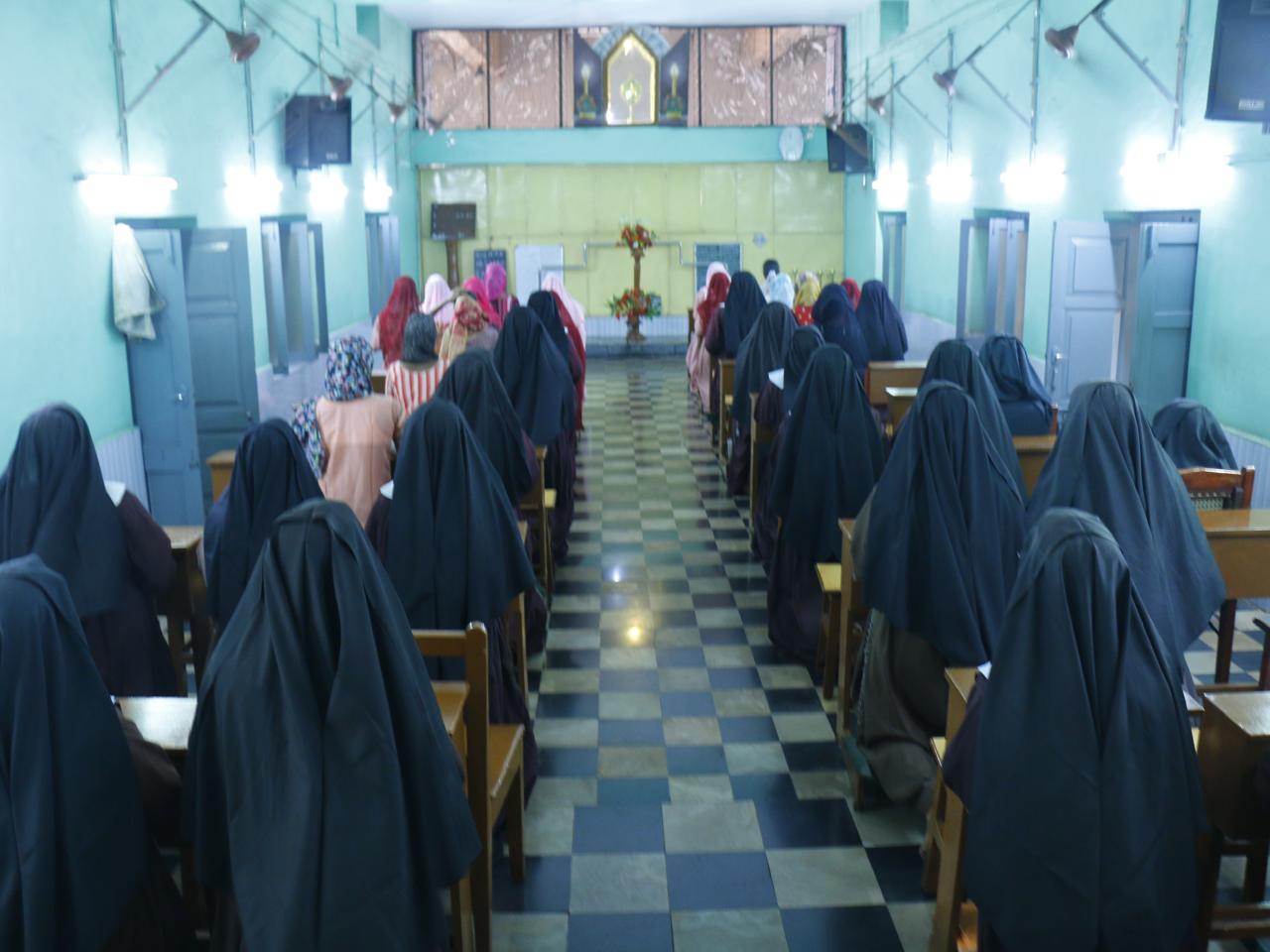
Contemplative Prayer
The words of His Holiness Pope John Paul II, addressed to our Poor Clare sisters at the protomonastery in Assisi on March 12 1982, continue to re- echo among the daughters of St.Clare: "In our age it is necessary to repeat St.Clare's discovery, because it is important for the life of the Church. You do not know, hidden and unknown as you are, how important you are in the life of the Church, how many problems, how many things depend on you. We need the rediscovery of that charism, of that vocation; we need the rediscovery of the divine legend of Francis and Clare".
Prayer is the heart of the Poor Clare way of life.
Prayer is life with Jesus; it is Jesus reliving the Gospel message in us.
— Pope Francis
'Place your heart in the figure of the divine substance.
And transform your whole being into the image of the Godhead Itself through contemplation'!
Contemplative prayer is hearing the Word of God. Contemplative prayer is quite simply the thirst for God. It is our answering God's ever-present, all-encompassing, everlasting, and very personal love. The vocation of a Poor Clare corresponds fully with the deepest aspirations of human nature.
The contemplative life is a life long journey to God in prayer and worship,
turning from all else that could make the journey less direct.
Contemplative nuns and monks are concerned less with themselves and
more with God and all those whom God loves. Prayer is essential for all
Christians, but contemplatives are called to make their whole lives a
prayer in solitude and silence and community. As lofty as this may seem,
contemplatives are human beings - HUMAN, yes indeed!
We seek to make prayer our whole way of living; a way of finding God in
all things and all things in God. Our life of prayer is the work of the Holy
Spirit in the depths of our being, forming us into the image of Christ. In
openness to the Spirit, we try to respond ever more generously to the
gentle invitation to complete self-surrender to the Father's will
(Constitutions 36, 45, 46).
In keeping with the earliest Franciscan tradition, the sisters will live the
eremitical form (St Francis' Rule for Hermitages 1217-1221) much loved by
St Francis and St Clare. They take inspiration from St Francis who always
sought out solitary places in nature and in the harmony of creation (1 Cel
27). This implies the practice of daily prayer, in solitude, in a hermitage. In
this way the Form of Life is rooted in contemplation. (Constitutions N36).
For Francis and Clare of Assisi their relationship with God was based on
faith that God became human in Jesus Christ. For them their relationship
with God was an intimate one; they wanted to follow Jesus as closely as
they could. Franciscan prayer is about becoming a new creation in Christ.
This kind of prayer is less about what we asking for and more about the
fact that with prayer, we become different people.
Our life is known as 'contemplative'. This means that we don't have any
external 'apostolate' or particular work that we are dedicated to carrying
out such as teaching or nursing. All our energies are instead directed to
communion with God in prayer and with one another within the
monastery in the service of the Church and of the world. Our role in the
Church is to show forth the truth that God is everything and the fulfilment
of the deepest desires of the human heart.
Of course this does not mean that we are on our knees all day or that we
don't work. The monastery is often a hive of activity as can be seen from
the photos in the gallery! Our work within the monastery is done in a
contemplative and community spirit that fosters communion with God.
“The contemplative life is the nun's particular way of being the Church, of
building the communion of the Church, of fulfilling a mission for the good
of the whole Church. Cloistered contemplatives therefore are not asked to
be involved in new forms of active presence, but to remain at the
wellspring of Trinitarian communion, dwelling at the very heart of the
Church…by means of constant prayer, the oblation of self and the offering
of the sacrifice of praise. Their life thus becomes a mysterious source of
apostolic fruitfulness and blessing for the Christian community and for the
whole world.”
Such is the life of the contemplative Poor Clare. Her mission is to be God's,
to let Him shine through her on all the darkness of misery which shrouds
the world. And as in St. Clare's age, so in our own, people understand this
without any need to reason about it. They flocked to Clare's poor little
monastery in the thirteenth century to ask her prayers for their sick, their
prodigals, and their friends. In our century, they continue to do so, taking
it for granted that the Poor Clares, cloistered from the world, are closer to
its heartaches and miseries than any others simply because they live
hidden in the embrace of God. To understand the contemplative vocation
properly is to know that its apostolate is universal and timeless.
The cloistered Poor Clare is destined for the spiritual maternity of
countless souls. The more perfect her life of love and reparation, the more
fruitful is her motherhood of souls. Consecrated virginity generates
tenderness and compassion beyond what any other love can attain, simply
because it is not limited. Virginal love partakes of the boundlessness of
Christ's love for souls. A Poor Clare's Divine Lover has a heart of infinite
Love. It is to be expected that her own capacity for love will go on
increasing as she grows in union with Him.
There are times when we suffer from weariness and dryness in our life of
prayer; and when that happens, we can simply remain. We can cling to the
altar of God as our Holy Mother Claare did. Or when life seems to have no
meaning, as it has to be sometimes for us, we simply cling to the altar of
God. We need fortitude to sustain our life of prayer. We need fortitude to
sustain charity in community. We need fortitude to be faithful in daily life.
We need fortitude as the virtue that will see us through the long haul,
which is what the contemplative life is about. Those auxiliary virtues of
peace, patience, perseverance, and magnanimity are all needed on the
long haul.
So we look to the example of Holy Mother Clare and her correspondence
with the grace of God, and we ask her to obtain the grace of an undaunted
heart for each one of us, because our heart will be undaunted if the
fortitude of the Holy Spirit, the strength of God, is allowed to work in it.
Let us ask Holy Mother Clare to help us to be wide open to the gifts and
graces that the Holy Spirit wants to give us.
